

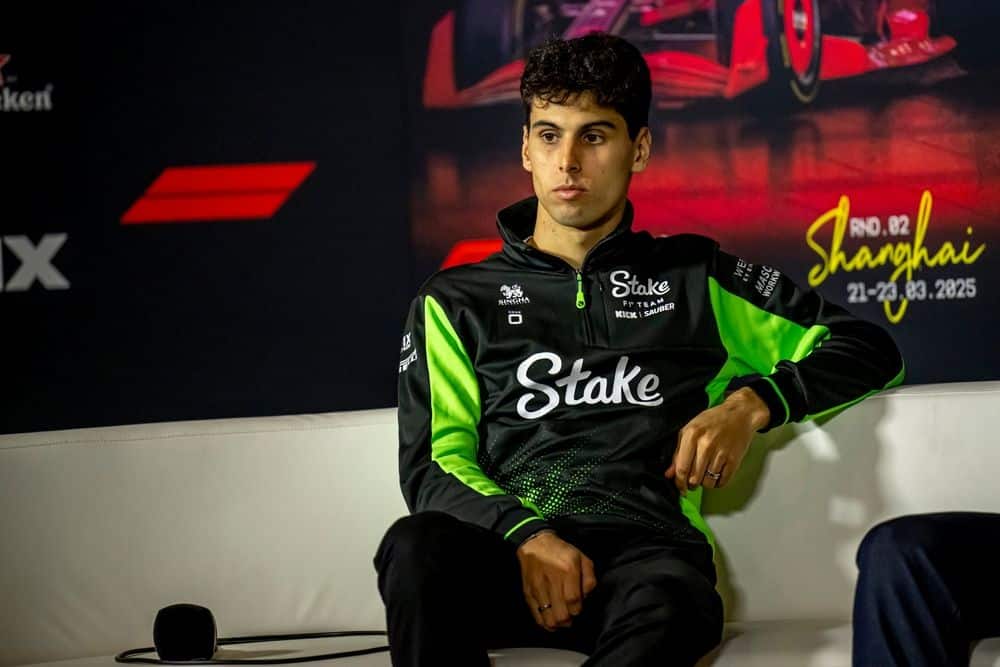
Gabriel Bortoleto, a 20-year-old Brazilian rookie in Formula 1 with Sauber in 2025, sparked buzz by comparing his admiration for Ayrton Senna and Max Verstappen in an interview on the Na Ponta dos Dedos podcast, hosted by ge, on Tuesday, August 5, in Rio de Janeiro. He called Senna, a three-time world champion, “unmatched” and above any other driver in history, while praising the technical precision of four-time champion Verstappen, with whom he has been friends since Formula 3. The statement, made ahead of the São Paulo GP on November 9, reflects Bortoleto’s connection to Brazil’s F1 legacy and his perspective on the sport’s evolution. The driver, who has scored points in races like Hungary and Belgium, highlights the influence of both on his career.
Bortoleto’s words resonate with fans, who see him as a hope to revive Senna’s glory. He described the three-time champion as “ahead of his time” and compared Verstappen’s driving to “near perfection.” The interview also revealed details of his relationship with Verstappen, with whom he trains in simulators.
Senna as a reference: Helmet inspired by the three-time champion used since 2024.
Friendship with Verstappen: Joint training and shared experiences since 2020.
F1 debut: Sixth place in Hungary, with 14 points in the season.
São Paulo GP: Expectation of massive fan support in Interlagos.
The young driver, representing Brazil after a seven-year absence of national drivers in the category, carries the responsibility of honoring a historic legacy while forging his own path.
Senna: an unmatched idol
Ayrton Senna, for Gabriel Bortoleto, is more than an idol—he is a symbol of genius. The Brazilian driver, born in 2004, ten years after Senna’s death, grew up hearing stories of the three-time champion, who won titles in 1988, 1990, and 1991. In the interview, he highlighted Senna’s ability to stand out in an era with less technology, where raw talent was decisive. “He was exceptional; no one will ever come close to what he did,” he stated.
Bortoleto adopted a helmet inspired by Senna’s iconic green and yellow design since Formula 2 in 2024. The tribute, first displayed in Imola, moved fans and went viral on social media. The driver also visited the Ayrton Senna Institute, reinforcing his commitment to his idol’s legacy. His devotion reflects the cultural weight Senna still carries in Brazil, especially among the new generation of drivers.
Iconic helmet: Design inspired by Senna used in Imola and F1.
Senna’s legacy: Three world titles and 41 wins in 161 races.
Senna Institute: Bortoleto supports the institute’s educational initiatives.
Emotional influence: Senna’s stories shaped the young driver’s career.
The comparison with Senna, though inevitable, is approached cautiously by Bortoleto, who acknowledges the differences between F1 eras but keeps the three-time champion on a unique pedestal.
Rest, rejuvenation and Pina Coladas 🍹🌞 pic.twitter.com/dj76n4PCcw— Stake F1 Team KICK Sauber (@stakef1team_ks) August 6, 2025
Verstappen: precision and modern inspiration
Max Verstappen, four-time world champion (2021-2024), is a contemporary reference for Bortoleto. The 27-year-old Dutch driver is praised for his precision in laps, advanced use of telemetry, and controlled aggression. “A pole lap from Max is almost perfect; he uses data like no one else,” Bortoleto said. Their friendship began in Formula 3 in 2020, when they shared simulator sessions and physical training.
Bortoleto notes that Verstappen, despite his youth, is already among the all-time greats, alongside Senna, Hamilton, and Schumacher. Their relationship extends beyond the track: before the Belgian GP in July 2025, they trained together in Spa, exchanging tips on racing lines. Verstappen, in a press conference at the Monaco GP, praised the Brazilian: “He’s fast and has a bright future.” This exchange of experiences has helped Bortoleto grow in F1.
Verstappen’s titles: Champion in 2021, 2022, 2023, and 2024.
Joint training: Simulators and light runs before GPs.
Mutual praise: Verstappen highlights Bortoleto’s potential.
Technical style: Telemetry use sets Verstappen apart in modern F1.
Verstappen’s influence is practical: Bortoleto studies his onboards to improve braking and overtaking points, which has already yielded results in the season.
F1 evolution: technology and challenges
Bortoleto’s comparison between Senna and Verstappen sheds light on Formula 1’s transformation over decades. In the 1980s and 1990s, driving relied more on intuition, with less predictable cars and fewer data points. Senna excelled on tracks like Monaco and Interlagos, often in the rain, using sheer talent. Today, F1 is driven by telemetry, with teams analyzing thousands of data points per lap to optimize performance.
Bortoleto acknowledges that modern technology allows fine-tuning, as mastered by Verstappen. “Today, every millisecond counts, and telemetry has changed everything,” he explained. He uses these tools at Sauber, despite the team’s car limitations. The Brazilian emphasized that, despite the differences, the essence of driving—courage and precision—remains unchanged.
Senna’s era: Cars with less electronics and higher physical risk.
Modern era: Telemetry and aerodynamics dominate today’s F1.
Sauber’s challenges: Less competitive car demands adaptation.
Technical evolution: Data enables real-time race adjustments.
This bridge between past and present reinforces Bortoleto’s view of F1: he respects history but is focused on excelling in the current era, with support from idols like Verstappen.
Expectations for Interlagos in 2025
The São Paulo GP, set for November 9, 2025, in Interlagos, will be Bortoleto’s first as an F1 race driver on home soil. The Brazilian fanbase, known for its passion, has already embraced him as a new hero. “Brazilian fans are unique; they defend you with everything,” he said, recalling their social media support. A record crowd is expected, driven by the return of a Brazilian driver after seven years.
Bortoleto anticipates an emotional atmosphere, akin to what Senna experienced in the 1980s and 1990s. He plans to use his Senna-inspired helmet again, which should heighten fan excitement. Sauber, though not among the top teams, could surprise with Bortoleto’s performance, given his points in demanding circuits.
GP date: November 9, 2025, in Interlagos.
Brazilian fanbase: Known for energy and unwavering support.
Special helmet: Senna tribute to be used at home.
Interlagos history: Track marked Senna’s wins in 1991 and 1993.
The event will also be a chance for Bortoleto to solidify his place in F1, with international media watching his performance in front of the Brazilian crowd.
Bright future at Sauber and beyond
The 2025 season has showcased Bortoleto’s potential, with 14 points earned, including a standout sixth place in Hungary. His adaptation to Sauber, a team transitioning to Audi in 2026, is impressive. He works alongside Nico Hülkenberg, with whom he has built mutual respect, and under new leadership like Mattia Binotto. “We’re building something big for the future,” he stated.
Bortoleto also hopes for another Brazilian, Felipe Drugovich, to join the F1 grid in 2026, possibly with Cadillac. The prospect of two Brazilian drivers excites fans and strengthens Brazil’s relevance in the sport. For now, Bortoleto focuses on maximizing his current car’s potential, despite its limitations, and learning from each race.
2025 points: 14 points, with a top-6 in Hungary.
Audi transition: Sauber will rebrand in 2026.
Hülkenberg partnership: Veteran aids rookie adaptation.
Drugovich dream: Support for another Brazilian in F1.
Bortoleto’s journey, marked by reverence for Senna and learning from Verstappen, positions him as a bridge between Brazil’s storied F1 past and a promising future.