

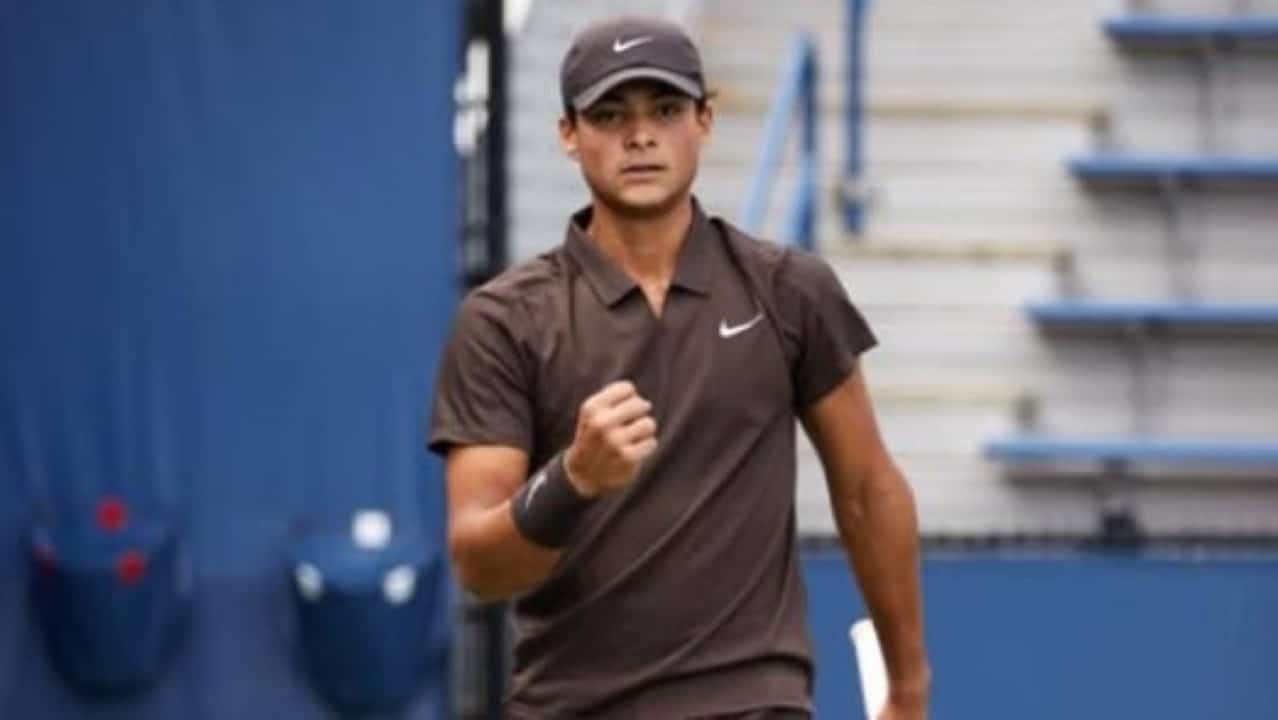
Guto Miguel, a 16-year-old Brazilian tennis prodigy from Goiás, secured a spot in the US Open junior semifinal in New York by defeating British player Oliver Bonding, ranked 17th globally, with a score of 7/6 (7-5), 2/6, and 6/1 on Thursday. This victory, marked by a stunning first-set comeback and overcoming an injury, marks his eighth consecutive win, following his title at the ITF J300 in Repentigny, Canada. Currently ranked 19th in the junior world rankings, Guto is earning 490 points with this campaign and could climb to 13th place, establishing himself as Brazil’s top junior tennis prospect. Despite physical challenges, he displayed resilience and tactical control, particularly in the decisive set, dominating his opponent. His next challenge is against Bulgarian Alexander Vasilev, the 5th seed, as he aims for an unprecedented Grand Slam final.
Guto’s tournament journey has drawn attention for its consistency and ability to overcome adversity. He faced a tough match against Bonding, who hit 10 aces, but neutralized the Briton’s powerful serve in the final set. Despite limitations in his own serve due to an injury, the Brazilian excelled with solid baseline play and competitive mentality, positioning him as a promising talent for professional tennis.
Epic comeback defines first set
The match against Oliver Bonding started with challenges for Guto Miguel. The Briton took a 4/1 lead in the first set, capitalizing on an early break and pressuring with powerful serves. Guto, however, responded with composure and precision, leveling the score at 5/5 and taking the set to a tiebreak. In the tiebreak, the Brazilian was more consistent, closing it out at 7/5 after 12 points.
- Key to the comeback: Guto stayed patient despite trailing 5/2, capitalizing on his opponent’s errors.
- Mental strength: His ability to recover under pressure was crucial to keeping the match in hand.
- Adjusted tactics: The Brazilian varied returns to counter Bonding’s aces.
The first-set win boosted his confidence, but the second set was dominated by Bonding, who faced no break points and broke Guto twice, closing at 6/2. The Brazilian, already feeling the injury, conserved energy for the decisive set.
Dominance in the final set
In the third set, Guto Miguel regained control with authority. Conceding only six points on his serve, he capitalized on Bonding’s dip in performance, who struggled to maintain his earlier serving precision. Two consecutive breaks gave Guto a 5/0 lead, and though Bonding avoided a “bagel” (6/0), Guto sealed the match in the next game, 6/1.
The final set showcased Guto’s ability to adapt to adverse conditions. Despite serving limitations, he excelled in baseline rallies and efficient movement. The Brazilian crowd in New York cheered his performance, and Guto thanked them in a post-match interview, showcasing fluent English honed by his time in the United States.
Ver essa foto no Instagram
Injury and resilience in focus
Despite his impressive performance, Guto Miguel’s injury raised concerns during the match. He requested medical attention in the second set, indicating issues with his serve. Nevertheless, he stayed focused and adjusted his game to minimize the injury’s impact.
- Medical attention: Guto received treatment between the second and third sets, aiding his continuation.
- Tactical adaptation: With a compromised serve, he prioritized long rallies and defensive play.
- Resilience: Playing through discomfort highlighted his mental toughness.
- Physical preparation: The work with his team, led by coach Santos Dumont, was key to his on-court recovery.
Guto’s resilience, combined with his technical skill, earned praise from commentators and fans, who noted his maturity at just 16. His US Open junior campaign is already considered historic for Brazilian tennis, especially in South America, where few have achieved such a feat at his age.
Next challenge against Vasilev
In the semifinal, Guto Miguel will face Bulgarian Alexander Vasilev, ranked 7th in the junior world and the tournament’s 5th seed. Vasilev, 18, defeated American Andrew Johnson 6/3, 7/5 and is in his second Grand Slam semifinal, having reached the same stage at Wimbledon. The matchup will be a tough test for the Brazilian, who must contend with Vasilev’s experience and his own physical condition.
Vasilev is known for his aggressive play and powerful serves, demanding a strategy similar to the one used against Bonding. Guto’s ability to vary pace and maintain baseline consistency will be key. The match is set for Friday in New York, with streaming expected on platforms dedicated to junior tennis.
Rising in the rankings
Guto Miguel’s US Open junior campaign solidifies his status as Brazil’s top tennis prospect. Currently 19th in the junior world rankings, he is earning 490 points with the semifinal and has only 140 points to drop. This puts him on track to reach 13th place, with a chance to break into the top 10 if he advances to the final or wins the title.
- Ranking points: The 490 points are based on the six best singles results and 25% of doubles.
- Projected climb: The exit of older players (18 years old) in 2026 could push Guto to the top 8.
- Historical comparison: Few Brazilians have matched this performance in Grand Slams at 16.
- Boost for Brazil: His campaign highlights the growth of Brazilian tennis, alongside names like João Fonseca.
Guto’s ranking rise reflects not only his talent but also his team’s structured work. Coach Santos Dumont has been pivotal in his technical and mental development, with Guto training at academies in the United States, explaining his English fluency and international circuit adaptation.
Fan and expert reactions
Guto Miguel’s victory sparked excitement on social media and within Brazil’s tennis community. Fans compared him to João Fonseca, another rising Brazilian star who shone in the junior circuit. Comments like “the universe sent two stars to Brazil” capture the enthusiasm for new talents.
Experts hailed Guto’s campaign as a milestone for South American tennis. His blend of technique, competitive mentality, and resilience, despite injury, drew praise, with analysts seeing potential for the professional circuit. Brazilian media is already speculating about his future, noting that while the junior circuit isn’t a guaranteed predictor, it increasingly identifies global standouts.
Brazilian junior tennis context
Guto Miguel’s performance underscores the positive phase of Brazilian junior tennis. Recent years have seen talents like Thiago Seyboth Wild and João Fonseca shine in Grand Slam juniors before transitioning to the pros. At 16, Guto has two more years in the category, which could further solidify his technical and mental foundation.
- Recent names: Thiago Wild won the US Open junior title in 2018; Fonseca reached the top 5 in 2024.
- Training structure: Academies in Brazil and abroad are investing in young talent development.
- Junior relevance: The junior circuit is a growing indicator of professional potential.
- Promising future: Guto can leverage predecessors’ experiences to plan his transition.
Guto’s US Open campaign highlights the importance of grassroots investment. Brazil, which has historically struggled to produce elite tennis players, is reaping rewards from structured programs in places like Goiânia and U.S. academies where Guto trains.
Semifinal expectations
The match against Alexander Vasilev will be a defining moment for Guto Miguel. Beyond a potential final berth, he has a chance to cement his name among the world’s top junior talents. His physical condition will be critical, as the injury could limit his performance in a high-intensity matchup.
Fans and analysts remain optimistic yet cautious. Guto’s ability to handle pressure, as shown in his comeback against Bonding, suggests he could pull off an upset. Brazilian supporters hope the young Goiano will continue to make history at the US Open, adding another milestone to the country’s tennis legacy.